What LVL is
LVL stands for Laminated Veneer Lumber. It is made by peeling logs into thin veneers, drying them, orienting the grain all in the same direction, and bonding them under heat and pressure into a solid billet that gets ripped into beams.
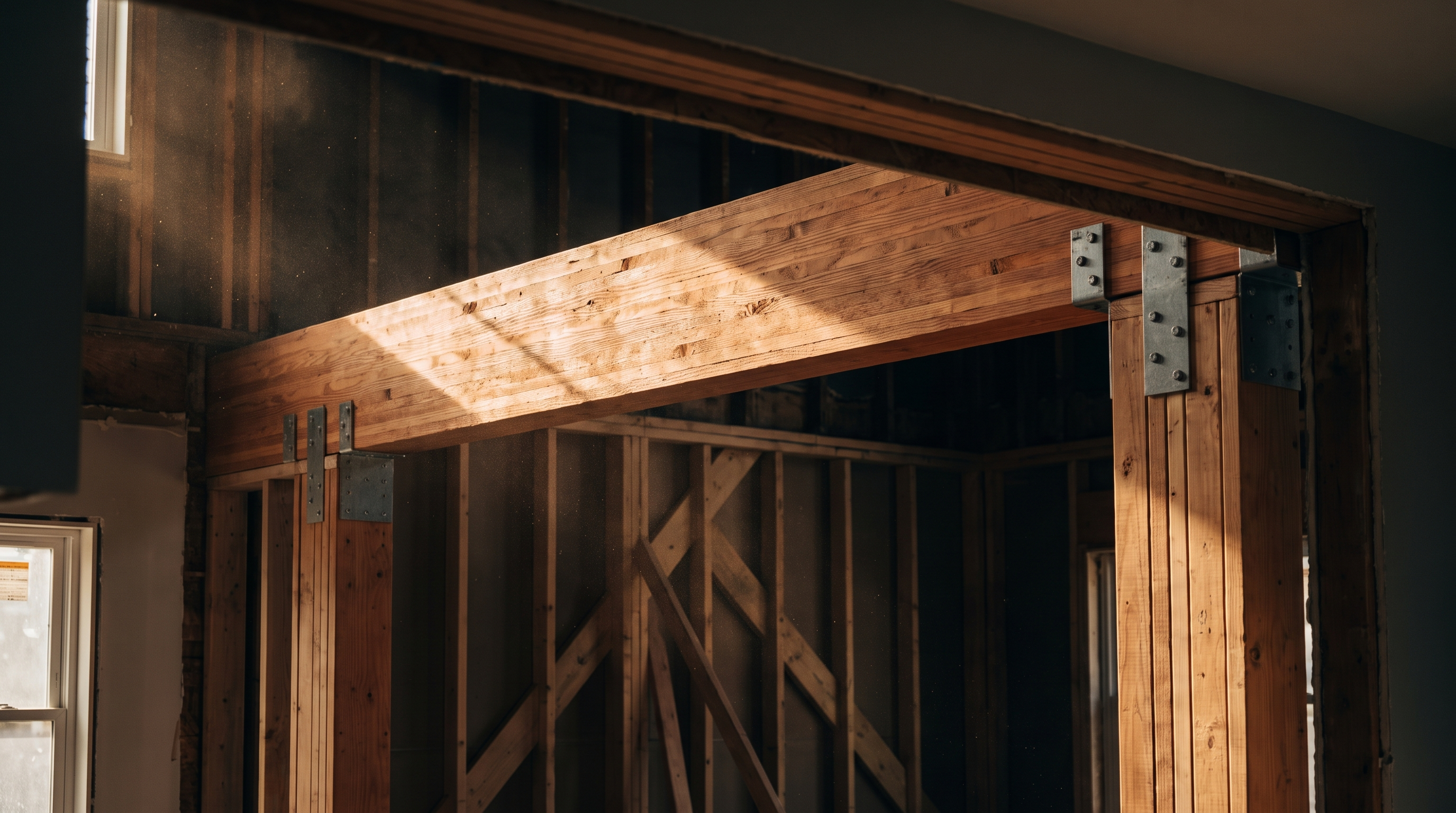
The result looks like very dense plywood standing on edge. A standard ply is 1¾ inches thick, and beams are built up by bolting or nailing plies together — two plies make 3½″ (a 2×4 wall), three plies make 5¼″, and so on. Common depths run from 7¼″ up to 24″.
You will see a stamp on the side with a grade like 2.0E. That is the modulus of elasticity — a measure of stiffness. Higher number, stiffer beam, less deflection over a given span.
Why it beats sawn lumber
A sawn 2×12 is one piece of a tree. It has knots, grain runout, internal stresses and a moisture history, and every one of those is a weak spot you cannot see. Structural engineers have to design around the worst plausible piece, not the average one.
LVL spreads defects out. A knot in one veneer is surrounded by dozens of clear ones, so its effect on the whole beam is negligible. That means:
- Higher allowable loads for the same depth — often roughly double a comparable sawn member.
- Longer spans without intermediate support.
- Dimensional stability. It does not crown, twist or shrink the way green lumber does, so ceilings stay flat and drywall joints stay closed.
- Predictability. Every beam of a given grade performs the same, which is what lets an engineer sign off on it.
Where we use it
On our jobs, LVL shows up in five places over and over:
- Load-bearing wall removals. By far the most common. A 12 to 20-foot LVL replaces the wall between a kitchen and a living room.
- Wide window and door headers. Sliders, multi-panel doors, and big rear-wall glass.
- Garage door headers, where the span is long and the roof load above is real.
- Floor girders in additions, carrying joists across a crawlspace or basement.
- Ridge beams in vaulted ceilings, where the ridge is structural rather than a simple ridge board.
Practical limits
LVL is not magic, and there are real constraints worth knowing before you plan around it:
- It cannot get wet. LVL is an interior product. Left exposed to weather it delaminates. It must be protected during construction and permanently dry in service.
- You cannot notch or drill it freely. Holes and notches are governed by the manufacturer specification. Cutting an LVL to make room for a duct without checking is a structural mistake, not a field decision.
- The ends need real bearing. A long LVL concentrates an enormous point load at each end. That load has to land on a properly sized post, and the post has to land on something that can take it — often a footing or a pier that has to be added below.
- It is heavy. A three-ply 20-foot LVL is a serious lift. Getting it into an occupied house through a doorway is often the hardest part of the day.
The beam is rarely the expensive item. The point loads at each end are. Transferring them down through the floor to a footing — sometimes cutting the slab and pouring a new pad — is where the budget on a wall removal actually goes.
LVL, PSL, Glulam and steel
- LVL — veneers all running lengthwise. Best strength-to-cost for beams and headers. The default.
- PSL (Parallam) — long strands bonded together. Stronger than LVL, takes higher point loads, used for heavily loaded columns and beams. More expensive.
- Glulam — dimensional lumber laminated flat. Can be curved and can be left exposed as a finish element. Often specified where the beam will be seen.
- Steel — the answer when the span is long, the load is heavy and the depth available is shallow. See our LVL vs steel guide.
Common questions
How much does an LVL beam cost installed?
Nationally, LVL beam installation runs roughly 50 to 200 dollars per linear foot including labor, with most single-opening projects landing between about 1,000 and 4,000 dollars. The beam itself is a small share of that. See our wall removal cost guide for how the whole job prices out.
Can an LVL beam be left exposed as a design feature?
It can be, but most people do not love how it looks — the laminations and stamps show. If you want an exposed beam, glulam or a wrapped LVL with finish lumber around it is the usual answer.
Can I drill a hole through an LVL for wiring?
Only within the manufacturer allowable hole chart, which depends on beam depth, hole size, and location along the span. Never in the middle of the depth near a support. Ask before drilling.
Does an LVL beam need to be supported by a post?
Yes. Every LVL beam bears on something at each end — usually a column of studs or a solid post sized for the load. Those posts must be continuous down to a foundation element that can carry the load.