Where the floor system closes
Floor joists run in one direction across the building. At each end they stop — and something has to close off those open ends and hold them upright.
That is the rim joist (also called the band joist or rim board). It runs perpendicular to the joists around the entire perimeter, nailed into the end grain of every joist.
It does three things at once: it keeps joists from rolling over sideways, it closes the floor cavity, and — the big one — it carries the load of the wall sitting on top of it down into the foundation below.
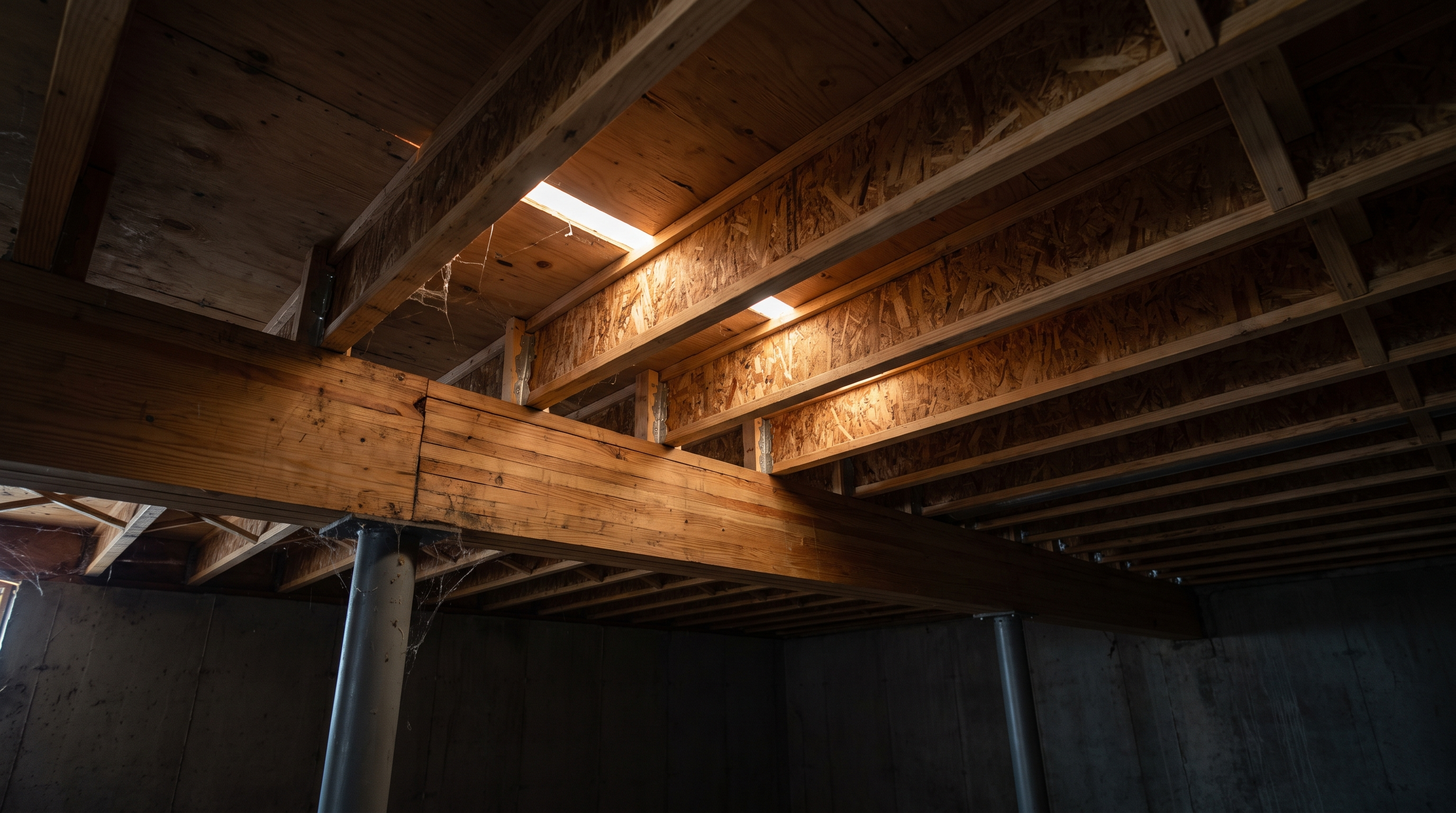
A busy piece of the load path
Think about what stacks up at that spot on a two-story house. The roof loads the second-floor exterior wall. That wall bears on the second-floor rim. The rim transfers that load down through the first-floor wall, onto the first-floor rim, and finally onto the sill plate and foundation.
All of that passes through a piece of lumber standing on edge, loaded across its grain. It works because the load is spread continuously along its length rather than concentrated. Which is exactly why point loads at the rim need special attention: a beam or a post landing on the rim, rather than on a proper column carried down to a footing, is a common and serious framing error.
On a wall removal, the new beam concentrates thousands of pounds at two points. If those points land over an unremarkable stretch of rim joist with nothing beneath it, the beam is not actually supported. Carrying that load to the foundation is usually the most involved part of the job.
The rot and termite hot spot
In Georgia, the rim joist area is where the majority of structural rot and termite damage shows up. The reasons stack:
- It is close to grade, where moisture is.
- It sits directly above the foundation wall or sill, which wicks moisture.
- In crawlspaces it lives in humid, poorly ventilated air.
- Deck ledgers are frequently bolted to it — and a badly flashed ledger dumps water straight into the rim.
- It is out of sight, so problems run for years before anyone notices.
Improperly flashed deck ledgers bolted to a rotted rim joist are the leading cause of catastrophic deck collapses. If you have a deck attached to your house and have never looked behind the ledger board, it is worth doing.
The biggest air leak in most houses
Beyond structure, the rim joist cavity is typically the single largest source of air leakage in a house. Every joist end creates a pocket, and those pockets connect conditioned space to a vented crawlspace or an unconditioned basement.
Fibreglass batts stuffed into rim cavities do essentially nothing — air passes straight through them. The effective treatment is spray foam or rigid foam cut to fit and sealed at the edges.
If you are already opening up a basement ceiling or having framing work done, sealing the rim is one of the highest-return energy improvements available, and the access is never cheaper than while the framing is exposed.
Common questions
What is the difference between a rim joist and a sill plate?
The sill plate lies flat on top of the foundation wall and is anchored to it. The rim joist stands on edge on top of the sill, capping the ends of the floor joists. They are stacked, not the same thing.
Can I cut a hole in the rim joist for a dryer vent?
Small penetrations are generally acceptable, but the rim is carrying real load, so size and location matter and multiple or large openings need thought. Seal thoroughly afterward — unsealed penetrations here leak air badly.
My rim joist is soft near the deck. What now?
Stop using the deck and have it looked at. Soft rim joist behind a deck ledger is the classic precondition for a deck collapse. Repair means removing the ledger, cutting out and replacing the damaged rim, and re-flashing properly.
Should I insulate my rim joist?
Yes, and with foam rather than batts. It is one of the largest air leaks in a typical house and one of the easiest to fix while framing is open.